
Nature has long provided valuable resources for both survival and traditional medicine. Many plants and natural organisms contain compounds that have been used for centuries to treat wounds, infections, and other health concerns.
One of the most interesting examples is usnea, a type of lichen sometimes called “Old Man’s Beard.” This unique organism grows on trees in forests around the world and has been used in traditional herbal medicine for generations.
Usnea is particularly well known for its natural antibacterial and antifungal properties. Because of these characteristics, it has historically been used to help treat infections, wounds, and respiratory problems.
For those interested in survival skills or bushcraft, learning about usnea medicinal uses can be valuable knowledge. In situations where modern medicine is unavailable, natural remedies may provide limited but helpful support.
How to Identify Usnea
Usnea is a type of lichen that grows on trees and is often easy to recognize once you know what to look for. It is commonly called “Old Man’s Beard” because of its thin, hair-like strands that hang from branches and bark.
Unlike many other lichens that grow flat against surfaces, usnea forms long, stringy clumps that drape from tree limbs. The color usually ranges from pale green to gray-green, depending on moisture levels and the surrounding environment.
One of the most reliable ways to identify usnea is by gently pulling apart one of its strands. Inside the outer layer, usnea contains a distinct white elastic core. If you slowly stretch the strand, the outer layer will separate slightly and reveal this thin inner thread.
This central core is a key identifying feature that helps distinguish usnea from similar-looking lichens. Usnea typically grows in small clusters or larger hanging masses on tree bark, especially on older trees.
It does not harm the tree itself, as it obtains nutrients from the air and rain rather than from the tree. Proper identification is always important when gathering wild plants or lichens, so beginners should study several examples before harvesting.
Where Usnea Grows
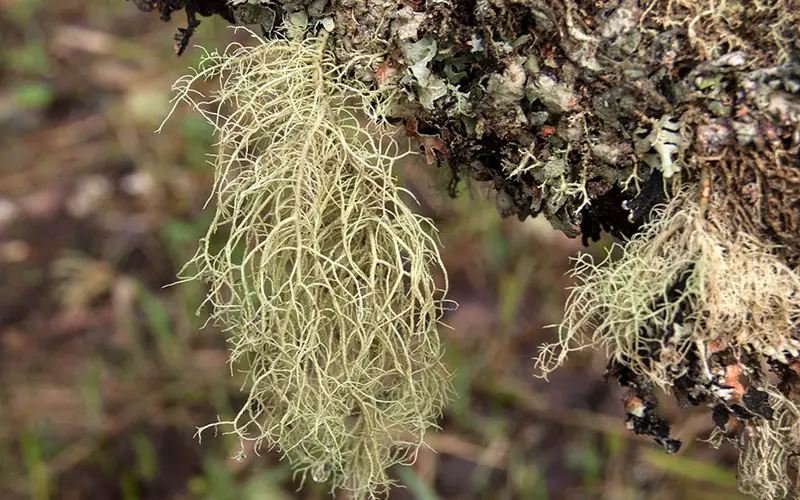
Usnea can be found in many parts of the world and is especially common in forested areas with clean air and good humidity. Because lichens are sensitive to pollution, they tend to grow best in environments where the air quality is relatively high.
You will often find usnea growing on the branches or bark of trees such as pines, firs, oaks, and other hardwoods. It prefers cool, moist forests, but it can also grow in mountainous areas and temperate climates.
In some regions, usnea may appear as small tufts on tree trunks, while in others it forms longer hanging strands that resemble thin moss. After storms or strong winds, pieces of usnea can sometimes be found on the forest floor where they have fallen from branches.
Forests with older trees and healthy ecosystems are often the best places to search for this lichen. However, it is important to harvest responsibly and avoid taking large amounts from a single area so the ecosystem can continue to thrive.
Usnea Medicinal Properties
Usnea has attracted attention in herbal medicine because it contains several natural compounds that may have antimicrobial properties. One of the most well-known compounds found in usnea is usnic acid, which has been studied for its potential antibacterial and antifungal effects.
Because of these properties, usnea has traditionally been associated with supporting the body’s natural defenses against certain microorganisms. Herbal practitioners have historically used preparations made from usnea in an effort to help manage minor infections or support general wellness.
In addition to its antimicrobial characteristics, usnea has also been explored for possible anti-inflammatory and antioxidant properties. These qualities may contribute to its long history of use in herbal remedies aimed at supporting skin health and respiratory comfort.
It’s important to note that while these properties have been explored in traditional medicine and scientific studies, natural remedies should not replace professional medical care.
Traditional Medicinal Uses of Usnea
For generations, various cultures have used usnea as part of traditional herbal medicine. Indigenous communities and early herbalists often prepared usnea in different forms such as teas, tinctures, or topical applications.
One of the most common traditional uses involved applying usnea preparations to minor cuts, scrapes, and wounds. Because of its antimicrobial reputation, it was sometimes used in an attempt to help keep wounds clean and reduce the risk of infection.
Usnea has also been used in herbal preparations intended to support respiratory health. Some traditional herbal practices included using usnea in teas or tinctures during times of respiratory discomfort.
In addition, herbalists have sometimes incorporated usnea into remedies aimed at supporting skin health, particularly in situations involving minor irritations or infections.
How Usnea Was Used in Survival Situations
Usnea has sometimes been mentioned in survival literature because of its historical reputation for antimicrobial properties. In traditional practices, it was occasionally used as part of improvised wound care.
Small amounts of cleaned usnea were sometimes placed on minor cuts or abrasions as part of basic field treatment. In addition to topical use, usnea has also been prepared as a tincture or infusion in some herbal traditions.
These preparations were sometimes used as part of broader herbal remedies aimed at supporting the body during illness. However, it is important to remember that survival medicine should always prioritize proper first aid techniques whenever possible.
Natural remedies like usnea should only be considered as supplemental knowledge rather than a replacement for professional medical care or proper medical supplies.
Safety and Important Considerations
While usnea has a long history in traditional herbal medicine, it should be approached with caution. Not all natural remedies are automatically safe, and improper use of medicinal plants can sometimes cause harm.
Some compounds found in usnea, including usnic acid, have been studied for both potential benefits and possible health risks. In particular, concentrated extracts of usnea have been associated with liver toxicity when taken internally in large amounts.
For this reason, many herbal experts advise avoiding internal use unless guided by a knowledgeable practitioner. Topical uses in traditional herbal practices are generally considered less risky, but caution and proper identification are still essential.
Another important consideration is accurate identification. Several lichens may appear similar at first glance, so beginners should always verify identification using reliable guides before collecting wild specimens.
Finally, responsible harvesting is important. Lichens grow slowly and play an important role in forest ecosystems, so only small amounts should be gathered and never from protected or sensitive areas.
