
Travel disruptions happen fast. One flagged item in your bag triggers a manual search, burning 30 critical minutes and causing you to miss your connection. You need a practical approach to navigate security without the friction. This guide covers everything from updated rules to gear and a same day staging routine so you move fast and land on time.
Jump to:
RELATED: Airport Go Bag | 10 Must-Have Items For The Prepared Traveler
Why TSA Lines Are Worse in 2026 (And Why It Matters)
Spring travel surges are pushing airport infrastructure to its absolute limits this year. High passenger volumes combined with strict screening protocols mean checkpoint lines are fully saturated. If they require you to undergo secondary screening due to a misplaced item, it’ll cost another 20 to 40 minutes at pre-check.
That delay creates a cascade effect. One flagged item leads to a delayed security clearance, which leads to late boarding and losing your overhead bin space. In worst case scenarios, you’ll end up missing flights. Passing through security smoothly requires everyday preparedness and a reliable system.
What Can I Bring Through TSA? (Packing Rules)
Knowing the baseline rules keeps you out of the secondary screening line. The goal is passing through the scanners without triggering a manual bag search.
TSA Rules for Carry-Ons
To ensure you pass through pre-check smoothly, you have to organize your gear into three distinct categories: electronics, food, and medical supplies.
Electronics
Organizing your tech for carry-on is about speed and complying with FAA safety standards for lithium batteries.
| Item | Carry-On Status | Precise Handling Instruction |
| Laptops | ✅ [ALLOWED] | Must be removed from your carry-on bag and placed in a separate bin for X-ray. |
| Power Banks | ✅ [ALLOWED] | Must be in your carry-on bag (strictly banned in checked luggage). Keep it accessible for inspection. |
| Cell Phones | ✅ [ALLOWED] | Can stay inside your carry-on or personal item. Do not leave it in your pocket. |
| Tablets / E-Readers | ✅ [ALLOWED] | Any device larger than a phone must be removed from your bag and placed in a bin. |
| Loose Lithium Batteries | ✅ [ALLOWED] | Carry-on only. Must be under 100Wh; keep them in your carry-on bag with terminals taped. |
| Chargers & Cables | ✅ [ALLOWED] | Can stay inside your carry-on bag. Keep them coiled to avoid “clutter” flags on the X-ray. |
Food & Snacks
-
✅ [ALLOWED]: Solid food only (granola bars, sandwiches, nuts, fruit).
-
✅ [ALLOWED]: Empty water bottle (fill after security).
-
❌ [BANNED]: Peanut butter, hummus, dips, applesauce, yogurt (liquid rule applies).
-
⚠️ [CAUTION]: Declare all food at international checkpoints.
Medications & Medical Devices
-
✅ [ALLOWED]: Prescription meds (no size limit, declare at checkpoint).
-
✅ [ALLOWED]: Insulin, EpiPens, CPAP (all carry-on allowed).
-
✅ [ALLOWED]: OTC meds over 3.4 oz (allowed, separate from 3-1-1 bag).
-
💡 [ADVICE]: TSA Cares program is available for medical travelers (call 72 hours before your flight).
What Are the Current TSA Rules For Carrying Liquids? (Updated 2026)
The TSA defines a liquid by its consistency rather than its intended use. If an item pours, pumps, spreads, or squishes, it is legally categorized as a liquid. This means items you might consider “solid” or “food” such as peanut butter, gel deodorant, or toothpaste are subject to the same strict restrictions as water.
Which Liquids Can I Pack And Which Gets Confiscated?
When carrying liquids through TSA, you must follow the 3-1-1 system. If a container is larger than 3.4 ounces (100ml), it’ll be confiscated, even if it’s only half-full.
The 3-1-1 Rule
3: 3.4 ounces (100ml) is the maximum size allowed for any individual container.
1: 1 quart-sized, clear, zip-top bag (3-1-1 bag) must hold all of those containers.
1: 1 bag is allowed per passenger in the security lane.
Liquid Consistency Guide: Obvious vs. Hidden TSA Red Flags
| ✅ Obvious Liquids (Follow 3-1-1 rule) | ⚠️ “Sneaky” Liquids (Often Confiscated) |
| Hydration: Drinking water, juice, and energy drinks | Spreads: Peanut butter, hummus, and jam |
| Hygiene: Shampoo, conditioner, and liquid soap | Gels: Toothpaste, gel deodorant, and lip gloss |
| Aesthetics: Perfume, cologne, and lotion | Aerosols: Shaving cream and spray-on sunblock |
TSA-Approved Way of Carrying Liquids
- Use TSA-approved travel bottles (3.4 oz or under).
- Switch to solid alternatives like bar soap, solid shampoo, and stick deodorant.
- Store your 3-1-1 bag in the outer pocket of your carry-on for fast access.
Exceptions
You don’t need the 3-1-1 Bag for the following items:
- Medications (prescription and OTC, declare separately)
- Baby formula, breast milk, juice (reasonable quantities, notify officer)
- Duty-free liquids (allowed if sealed in a tamper-evident bag with the receipt)
What are the TSA Prohibited Items?
You don’t want to surrender expensive gear, so pack your loadout correctly the first time around.
Never Allowed (Carry-On or Checked)
- Explosives, flares, strike-anywhere matches
- Loose lithium batteries over 100Wh
Carry-On Only Restrictions (Fine in Checked Bags)
- Knives over 2.36 inches
- Multi-tools with blades
- Firearms (must be checked and declared with the airline)
- Aerosols over 3.4 oz
- Pepper spray
Checked Baggage TSA Rules: Checked Luggage Sizes and Checked Bag Weight Limit
Oversized bags and prohibited checked items cause massive delays behind the scenes. Know the hard limits for your check in baggage.
| Carrier Type | Max Size | Max Weight |
| Most US domestic | 62 linear inches | 50 lbs |
| Oversize fee triggers at | 63+ inches | 51-70 lbs |
What TSA Checks in Your Checked Bag
- Dense or irregular packing triggers manual inspection.
- Loose lithium batteries will be confiscated (they must be in your carry-on).
- Firearms must be declared, unloaded, and secured in a hard-sided locked case.
Pack to Pass
- Place heavy items on the bottom and build flat layers moving up.
- Keep all electronics in your carry-on bag.
- Use TSA-approved locks only (Travel Sentry or Safe Skies certified).
TSA-Approved Gear and Baggage Check-In Loadouts
Now that you know the TSA rules, your gear needs to physically match them. Slapping a generic “TSA-Approved” label on a product means nothing if it fails at the scanner. The gear below meets the specific legal criteria for dimensional limits, transparency, and battery compliance.
Best TSA-Approved Carry-On Luggage

- Why it passes: TSA guidelines dictate that your bag must physically fit through their X-ray tunnel and meet standard airline carry-on limits. The Omni 20-inch has an overall exterior dimension of roughly 22 x 15 x 9.5 inches including the wheels. This clears the standard domestic size limits, meaning agents will let it roll straight through the scanner.
💡 Field-Tested Proof Tip: If an agent ever questions the size of your bag, do not argue. Confidently drop it directly into the metal airline sizer bin at the gate to instantly prove it complies.
Best TSA-Approved Locks for Luggage

- Why it passes: TSA requires passengers to use officially recognized locks if they want their checked or carry-on bags secured. These Forge locks feature the official red diamond Travel Sentry logo. This indicates that TSA agents possess the specific master key code to unlock, inspect, and relock your gear without cutting the cable.
💡 Field-Tested Proof Tip: Always ensure the red diamond logo is facing outward when you lock your zippers. If an agent sees that logo immediately, they know they have the master key on their belt and will not reach for the bolt cutters.
Best TSA-Approved Toiletry Bottles & Bags

- Why it passes: TSA strictly enforces the 3-1-1 liquids rule. These specific silicone bottles hold exactly 3 ounces (89ml), sitting safely below the 3.4 ounce legal limit. The set also includes a transparent, one-quart compliant bag, allowing agents to visually clear your liquids instantly.
💡 Field-Tested Proof Tip: Agents do not care how much liquid is left inside. They only look at the maximum capacity of the container. A Sharpie mark or a custom sticker saying “3 oz” means nothing. Only use bottles like the Mrsdry that have the capacity physically molded into the silicone.
Best TSA-Approved Power Banks

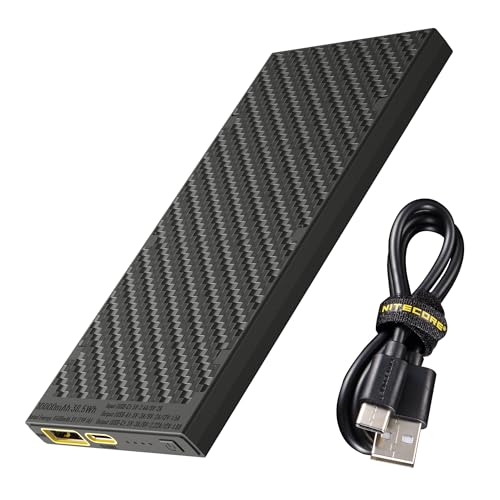
- Why it passes: The FAA legally caps loose lithium-ion batteries at 100 Watt-hours (Wh) for carry-on transport. The NB10000 holds a 10,000mAh capacity, which translates to exactly 38.5Wh. Because it falls drastically below the strict 100Wh restriction and has the specs printed directly on the chassis, it is 100 percent legal for cabin travel.
💡 Field-Tested Proof Tip: If you carry a rugged power bank for years and the factory spec label rubs off, TSA will treat it as an oversized battery and confiscate it. The day you buy your power bank, put a piece of clear, heavy-duty packing tape directly over the printed specs to seal the proof permanently.


Last update on 2026-03-25 / Affiliate links / Images from Amazon Product Advertising API
Tips on How to Pass Through the TSA Security Line Faster
On travel day, execute the following:
- Wear slip-on shoes.
- Place your belt, watch, and loose coins in your bag before you join the line.
- Keep your laptop and power bank on top of your carry-on contents.
- Store your 3-1-1 liquids bag in an outer pocket so you can pull it in one move.
- Know your lane. Ensure you are in the PreCheck or standard lane accurately to avoid starting over.
- Have your ID and boarding pass out before you reach the podium.
- Execute your bin strategy perfectly. Put your shoes and 3-1-1 bag in the first bin, and your bag in the second. Do not stack bins.
For full TSA guidelines, see their official page.
Frequently Asked Questions (TSA What Can I Bring)
What are TSA carry on rules in 2026? You are allowed one carry-on and one personal item. The maximum size is 22x14x9 inches for most carriers. Liquids must follow the 3-1-1 rule. Large electronics may need to be removed for screening. No blades over 2.36 inches are allowed.
What is not allowed in a carry-on bag? You cannot bring knives, multi-tools with blades, firearms, aerosols over 3.4 oz, or loose lithium batteries over 100Wh. You can find the full comprehensive list of prohibited items tsa flags at TSA.gov.
How strict is TSA about the 3-1-1 rule? They are very strict. The container size itself is what gets measured, not the fill level. Oversized containers will get confiscated even if they are nearly empty.
Can I bring a tactical pen or multi-tool on a plane? You can bring tactical pens through carry-on as long as they have no blade. Multi-tools with blades are strictly limited to checked bags only.
What’s the weight limit for checked bags? The limit is 50 lbs for most US domestic carriers. Going over 50 lbs triggers overweight fees. Bags over 100 lbs are generally refused by the airline entirely.
Are TSA-approved locks required for checked bags? They are not required by law, but they are strongly recommended. Non-TSA locks will be permanently cut off if security agents need to inspect the inside of your bag.
What happens if TSA finds something prohibited? You will be asked to return the item to your car, mail it home, or surrender it. In serious cases involving weapons, you will be referred to law enforcement. You cannot bring prohibited items through.
