
The power goes out at 9 p.m. You grab the flashlight from the drawer, click it, and nothing happens. Then you head to the garage, pull the generator cord 6 times, and it coughs once and quits.
That’s the night most families find out their backup gear was only backup on paper. Gear that sat for a year can fail without any warning sign.
The fix is a short backup power check you do twice a year. The step people skip is the generator load test in step 4, and it’s the one that tells you the most.
At a Glance: the backup power check
- Alarms: Press test on every smoke and CO alarm. Swap batteries yearly unless the alarm has a sealed 10-year battery.
- Lights and spares: Click on every light. Pull batteries from gear you won’t use for months.
- Power stations: Check the charge, then time a lamp on it to see real run time.
- Generator: Start it outdoors, 20 feet from the house, and run it with something plugged in.
- When: Do the full backup power check each time the clocks change. Test alarms and start the generator monthly in between.
Survival Life earns a commission if you buy through the Amazon links on this page, at no extra cost to you. It doesn’t change what we recommend or the order we recommend it in.
1. Test every smoke and CO alarm first
Start with the gear that wakes you up. Press and hold the test button on each alarm until it sounds, then move to the next one.
Test smoke and CO alarms monthly, and change the batteries at least once a year unless the alarm has sealed 10-year batteries. The clock change is an easy date to tie that swap to. This fall, it’s Sunday, Nov 1.
Now take one alarm down and look at the back. There’s a date printed on it. Replace any smoke alarm more than 10 years old, even if the test button still works.
Count your CO alarms
Carbon monoxide (CO) is the gas a generator or a gas heater can push into your home. You can’t see it or smell it.
You want a battery-powered CO alarm, or one with battery backup, on every level of the home and outside sleeping areas. A plug-in alarm with no battery goes quiet in a blackout, which is the exact time you’d be running a generator.
Alarms done. Next come the lights you’d grab in the dark.
2. Click on every flashlight and radio
Gather every light and radio in the house onto one table. Click each one on. If it’s dim or won’t light, open it up.
A white or crusty spot on the battery or the springs means a battery leaked. Clean the contacts or retire the light. Then fix the habit that caused it.
Battery makers say to pull batteries out of a device you’re not using and never mix old and new ones. Keep the spares somewhere cool and dry, at room temperature. So the light that lives in the hall closet all year should keep its batteries in a bag taped to it, not inside it.
Keep loose spares in a case, not a junk drawer. Loose cells touching keys or coins can short out. Our guide to how long emergency batteries last in storage shows how to test and restock the spares.
If you’re restocking spares for AA lights, a 24-pack of AA lithium batteries covers a lot of flashlights. They aren’t rechargeable, so skip them for gear that charges by USB. (paid link)
Don’t skip the radio
A battery or hand-crank radio is how you hear what’s happening when the phone is dead. Turn it on and find a local station. If it has a crank, give it 1 full minute of cranking and see how long it plays.
No radio that works without the wall? This one runs on a hand crank, a small solar panel or a USB charge, and picks up the weather band. Cranking fills it slowly, so charge it from the wall before you put it away.
As an Amazon Associate, Survival Life earns from qualifying purchases.
Last update on 2026-10-26 / Affiliate links / Images from Amazon Product Advertising API
That covers the small gear. Rechargeable gear has its own trap.
3. Check that power stations and power banks still hold a charge
A battery power station, or a phone power bank, loses charge just sitting on the shelf. The only way to know is to look.
Read the number, then write it down
Turn it on and read the charge on the screen. Write that number and today’s date on a strip of tape on the case. Next time you check, a big drop since the last top-up is your early warning that the battery is wearing out.
Your manual tells you how to store it. As one example, a maker of a large home unit tells owners to cycle the battery every 3 months and store it at about 60 percent, ideally between 68 and 86°F. Check yours, because models differ.
Phone power banks count too
The little power bank in your bag drains the same way. Plug a phone into it and watch the phone’s percentage climb for 10 minutes. If the bank dies first, it’s done.
Time a real load
Plug in a lamp with a bulb whose wattage you know, and time how long the station runs it. That’s your real number, not the one on the box.
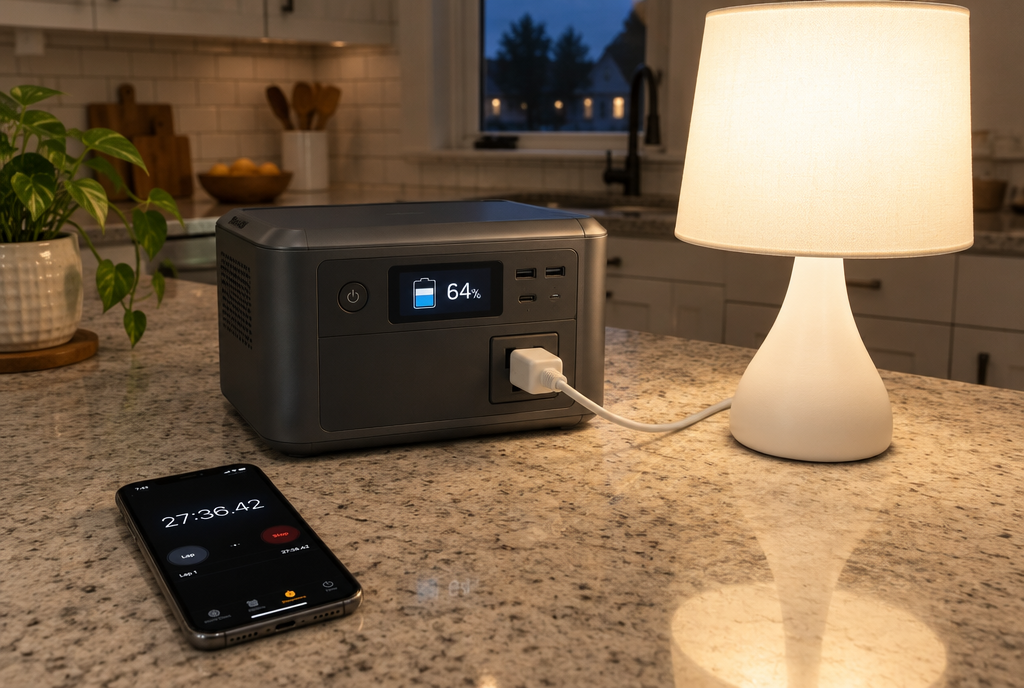
Here’s a rough way to read it, as an estimate. A station rated at 500 watt-hours running a 50-watt load would run for about 10 hours before losses, and inverter losses cut that. If yours quits far sooner, the battery has aged.
(Also check where it lives. A garage that drops below freezing is a bad home for charging, because charging a lithium battery below 32°F can cause lithium plating that permanently cuts its capacity. Bring it inside to charge.)
If the unit fails the test and you’re shopping for a replacement, our ranked guide to portable power stations for home backup compares sizes. You don’t need one to pass this check, though. Working lights and alarms come first.
Now the loud one in the garage.
4. Start the generator outside and run it under load
A common reason a stored generator won’t start is old fuel.
Fuel stored for over 30 days without a fuel stabilizer can break down and damage the fuel system. And stabilizer only protects fresh gas. It won’t bring stale fuel back.
If the gas in the tank is from last winter, drain it the way your manual says and start fresh.
For the fresh gas, a Type I safety gas can with a flame arrester and a self-closing lid keeps it sealed. It holds 2 gallons, and you still add stabilizer. (paid link)
Move it out first
Roll the generator out to the open yard or the end of the driveway before you pull the cord. Run generators outside only, at least 20 feet from the house, with the exhaust facing away, and never inside a garage, even with the door open. A test run makes the same exhaust a storm run does.
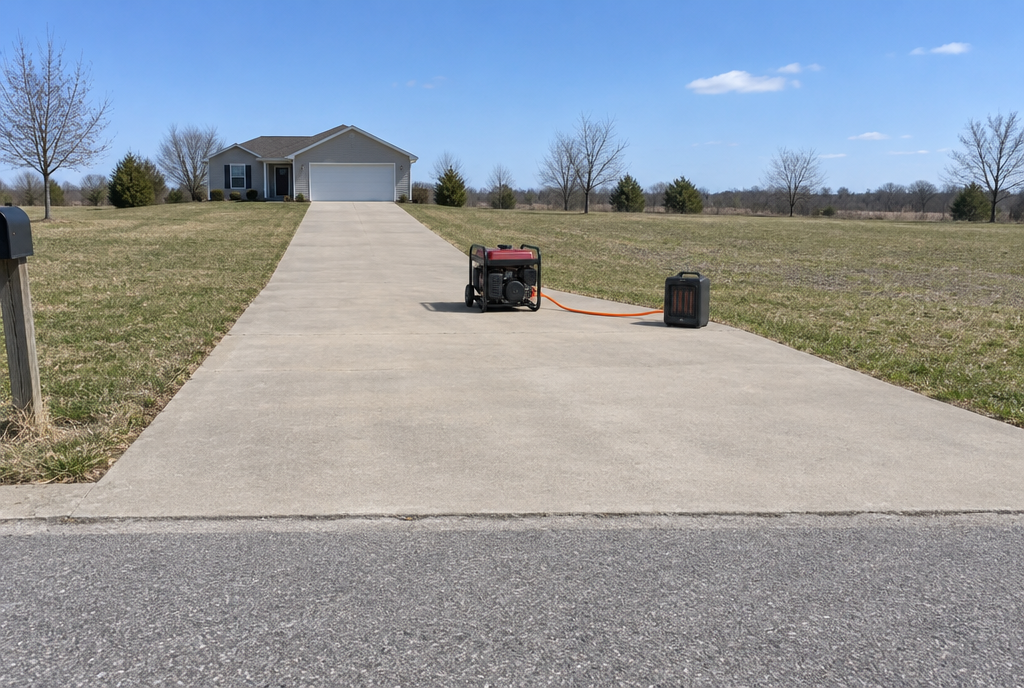
Check the oil level before you start it. Then start it and plug in something that draws real power, like a space heater or a work light. A generator that idles fine can still stall the moment you load it, and you want to learn that today, not in the dark.
How often to run it
Follow your owner’s manual first. Some makers say that if you run it less than once a month, drain the carburetor before it sits.
If your manual is silent, our rule of thumb is a monthly start with a 20 to 30 minute run under load. That’s our recommendation, based on how fast untreated fuel goes bad. One more thing: some makers cap ethanol at 10 percent for their generators, so read the label on the pump.
Our full guide on buying, using and maintaining a generator covers oil changes and spark plugs.
5. Put the backup power check on the calendar
Gear checks fail because nobody remembers them. So tie the full check to a date the whole house already knows: the 2 days a year the clocks change.
The small jobs run in between. Press each alarm’s test button once a month, and start the generator monthly if you own one.
Top up a power station every 3 months, or as its manual says.
Make it a family job. One person tests alarms while another lines up the lights.
Kids love pressing the test button (cover your ears).
There’s a reason this matters beyond the gear. In an outage, every surprise is one more decision you have to make in the dark, and stress makes those decisions harder. Gear you’ve already checked takes those decisions off the table.
Want to see how it all holds up? Our blackout weekend drill walks your family through a full outage at home, on purpose, on a day you pick.
Common mistakes with backup power gear
- Trusting the test button only. It proves the alarm sounds today. It doesn’t tell you the alarm is past 10 years old. Check the date.
- Storing lights with batteries inside. Batteries left in for a year can leak and ruin the light. Store them beside it.
- Never loading the generator. Idling for 5 minutes hides problems. Plug in a real load.
- Running the test in the garage. Even with the door up, exhaust can drift into the house. Go 20 feet out.
- Charging a power station in a freezing garage. Bring it inside to charge when it’s below 32°F.
- Buying new gear before checking the old. Most of this check costs nothing. Test what you own first.
Frequently asked questions
Test every smoke and CO alarm, click on every light and radio, read the charge on any power station or power bank, and start your generator outdoors with a load plugged in. Doing it twice a year, when the clocks change, keeps it on the calendar.
At least once a year, unless the alarm has a sealed 10-year battery. Test each alarm monthly, and replace any smoke alarm more than 10 years old.
Follow your owner’s manual first. If it doesn’t say, start it once a month and run it 20 to 30 minutes with something plugged in, outdoors and at least 20 feet from the house.
Yes, it drains slowly on the shelf. Read the charge every 3 months or as your manual says, top it up, and store it the way the manual says. One large unit’s manual says to cycle it every 3 months and store it near 60 percent.
Not below freezing. Charging a lithium battery below 32°F can permanently cut its capacity. Bring it inside to charge.
Do one thing today
Tonight, press the test button on every alarm in your house. Write today’s date on a strip of tape and stick it inside the closet where your flashlights live.
Quick poll: When did you last test your backup power gear?
A full check takes about an evening. Skipping it saves the evening, but you find out what’s dead during the outage instead.
What failed the last time you checked? Tell us in the comments.
