
Survival Life earns a commission if you buy through the Amazon links on this page, at no extra cost to you. It doesn’t change what we recommend or the order we recommend it in, and the cheapest option gets equal space.
During a boil water advisory, only boiled, bottled or stored water goes in anyone’s mouth. That covers drinking, cooking, brushing teeth, making ice, mixing formula and filling the pet bowl. Bring tap water to a full rolling boil for 1 minute (3 minutes above 6,500 feet), let it cool, and store it covered. Most people can still shower and wash their hands with tap water and soap. The advisory ends only when your water utility or state health department says it does.
At a Glance
- Boil for 1 full minute at a rolling boil (3 minutes above 6,500 feet), or use bottled or stored water.
- Fridge and pitcher filters don’t make advisory water safe. They aren’t built to remove bacteria and viruses.
- Dump the ice and turn off the ice maker. It was made with the same water.
- Showers and handwashing are usually fine. Don’t swallow, and give babies sponge baths.
- When it’s lifted, flush before you drink. Run cold taps for at least 5 minutes and reset the ice maker.
Here’s how fast one lands. Before dawn on September 16, Wichita’s main pump station and treatment plant lost power for about 45 minutes. The backup generators the city had switched to ahead of storms failed, water pressure dropped, and roughly 500,000 people in Wichita and a dozen connected communities were told to boil. Weak morning shower pressure was the first sign for most of them. The city advisory was lifted about 36 hours later, after lab tests came back clean. Families who already had water stored never needed to join the line at the store.
What should you do the moment a boil water advisory hits?
- Set aside today’s drinking water. Pull out your stored or bottled water, or put a pot on to boil. Stores run low fast when half a million people get the same text.
- Turn off the ice maker and dump the bin. Toss every ice cube in the freezer, too.
- Tape a note over every faucet. Kids brush their teeth on autopilot.
- Stop using the fridge water dispenser. Its filter doesn’t make this water safe.
- Check whether your town is included. Suburbs that buy water from a larger city are often under the same advisory, and sometimes for longer. In Wichita, one resident’s reaction summed up the confusion: “It would be nice if they included all the cities getting wichita water.” Check your own utility’s page, not just the big-city news.
- Sign up for your utility’s text alerts if you haven’t. That’s how you’ll hear it’s over.
What can you use tap water for during a boil water advisory?
| Room | Safe to do | How |
|---|---|---|
| Kitchen: drinking & cooking | Boiled, bottled or stored water only | 1-minute rolling boil, cooled, covered |
| Kitchen: washing produce | Boiled or bottled water | Same as drinking |
| Kitchen: dishes by hand | Yes, with a sanitizing soak | Wash and rinse in hot water, soak 1 minute in 1 tsp unscented bleach per gallon of warm water, air dry |
| Kitchen: dishwasher | Usually yes | Only with a sanitize cycle or a final rinse of at least 150°F |
| Bathroom: brushing teeth | Boiled or bottled water only | Keep a labeled cup by the sink |
| Bathroom: shower/bath (adults) | Yes | Keep your mouth closed and don’t swallow |
| Bathroom: babies & toddlers | Sponge bath | Reduces the chance of swallowing water |
| Bathroom: handwashing | Usually yes, with soap | Scrub 20 seconds. Follow local instructions if they differ |
| Laundry | Yes | No change needed |
| Pets | Boiled (cooled) or bottled water | Wash bowls after the advisory lifts |
A note on boiling. Many electric kettles shut off the second the water starts to boil, which falls short of a full minute. A pot on the stove lets you time it. Let the water cool in the pot with a lid on, then pour it into clean containers and label them “BOILED.”
How do you protect babies, older adults and anyone with a weak immune system?
These are the people most likely to get sick from contaminated water, so give them the most protection:
- Infants: use ready-to-use formula if you can. If you mix powdered formula, use bottled water or water that was boiled and cooled.
- Anyone immunocompromised, including people going through chemotherapy, transplant recipients and people with advanced HIV: call their doctor on day one and ask what extra precautions apply.
- CPAP humidifiers and home medical equipment: fill with distilled or bottled water, as most manufacturers already recommend. Empty and clean them once the advisory lifts.
- If anyone develops vomiting, diarrhea or fever, call a doctor. Don’t try to manage it at home past the first signs, especially with an infant or an older adult.
Should you boil, store or buy water when the power goes out too?
Experts genuinely split on this one. One side says boiling is a skill, not a purchase: a pot and a flame are all a household needs. The other side points at what caused this advisory in the first place, which was a power failure. If your own power is out, or you cook on an electric range, boiling stops being a skill and becomes an energy problem. Stored water is the only option that doesn’t depend on a working grid.
Here’s how to decide:
- Your power and stove work, and nobody at home is high-risk: boil, and keep stored water as the backup.
- Your power is out too, you only have an electric stove, or there’s an infant, someone frail or someone immunocompromised at home: use stored or bottled water first. Save boiling for dishes and washing.
- Your stored water will run out before the advisory is likely to lift: boil to refill clean containers while you still have power.
Never run a camp stove, grill or generator indoors to boil water. Carbon monoxide builds up fast, even with a window open. For backcountry and grid-down methods, see how to purify water in an emergency.
Can you boil your way through a power outage?
Assumptions: Four people, one gallon each per day for drinking and cooking. The Wichita advisory lasted about 36 hours, so the household needs 6 gallons. Tap water starts around 70°F.
The math: Heating one gallon (about 8.3 lb of water) to a boil takes roughly 0.35 kilowatt-hours (kWh), and holding a full rolling boil for a minute on a 1,500-watt kettle adds another 0.025 kWh. With heat loss, figure about 0.4 kWh per gallon. Six gallons comes to about 2.4 kWh. A typical 1,000 watt-hour home power station delivers about 850 usable watt-hours, enough to boil only about 2 gallons. Many smaller stations can’t power a 1,500-watt kettle at all.
What breaks it: a gas stove changes everything, as long as the gas stays on. Longer advisories multiply the math, and suburbs in Wichita’s system waited longer than the city itself. Two 5-gallon containers filled ahead of time cost less than a tank of gas and use zero watts.
What should you do after a boil water advisory is lifted?
Wait for your own utility’s all-clear. When a big city lifts its advisory, the neighboring towns that buy its water may still be testing their own samples.
On the details, utility guidance disagrees, and it’s worth knowing that up front. Some utilities say to run the taps, dump one batch of ice, and leave your filters alone. Others say to dump three batches and replace every filter that took in advisory water. Here’s the rule: if your utility’s notice gives steps, follow them exactly. If it doesn’t, use the careful version:
- Run every cold tap for at least 5 minutes, including the kitchen sprayer and the fridge water dispenser.
- Make and discard three batches of ice before you use it again.
- Replace filters that took in advisory water: fridge filters, pitcher cartridges, under-sink units. A fridge filter costs far less than a stomach bug.
- Run the empty dishwasher through one full cycle.
- Wash pet bowls, water bottles and the toothbrush cup in fresh tap water.
- Empty and clean CPAP humidifiers, baby-bottle gear and room humidifiers.
How much water should you store before the next advisory?
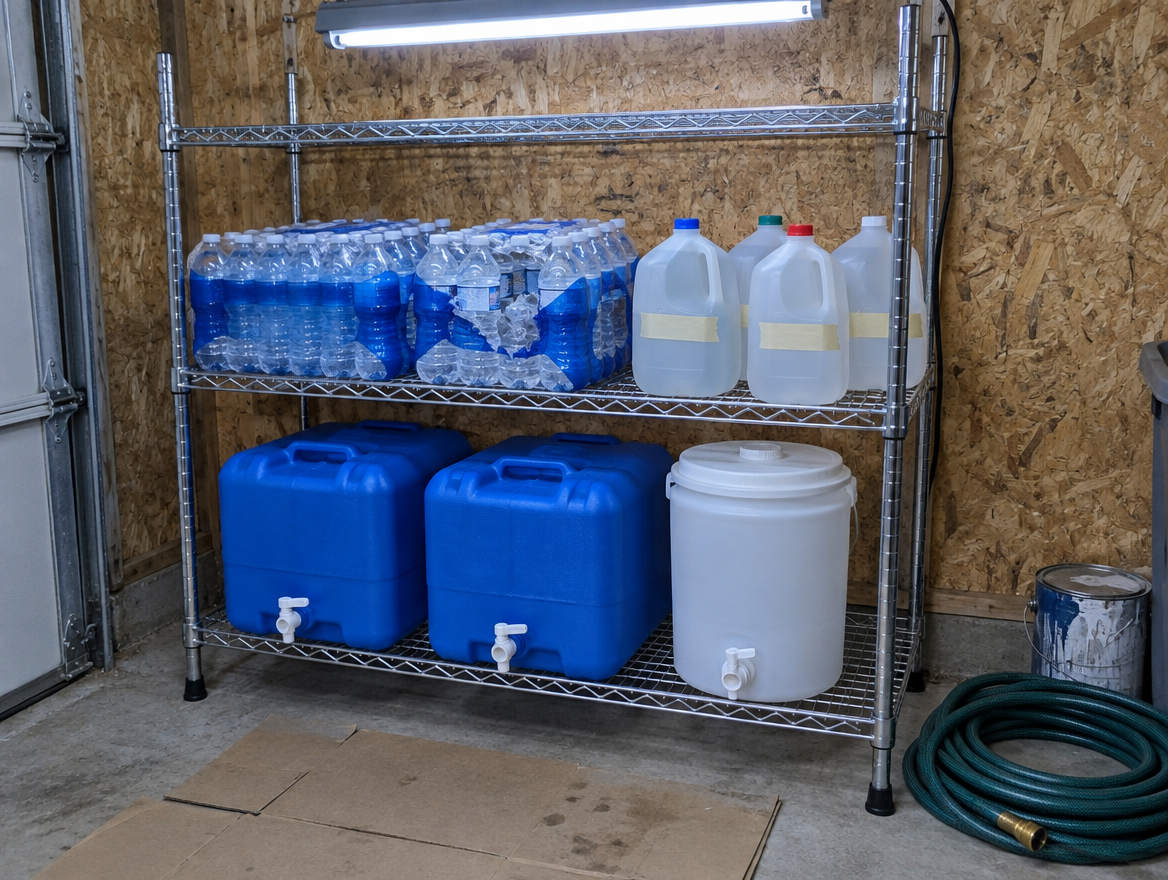
Plan on one gallon per person per day, for at least three days. A family of four needs 12 gallons. Build it the same way you build a grocery budget: add a case or one refillable container each shopping trip. Our guide to setting up long-term water storage at home covers containers and rotation in detail.
Good
$15–$30
Cases of bottled water rotated through normal use, plus one or two food-grade containers you fill from the tap and date.
Better · where most land
$40–$120
Two to four stackable food-grade containers, filled and dated, refreshed every 6 months. That’s the 12 gallons a family of four needs for three days.
Best
$150–$400
Stored containers plus a bathtub bladder for longer outages, and a countertop or gravity filter independently certified to remove bacteria and viruses. Check the certification before you trust it during an advisory.
Here’s where to start on Amazon. A collapsible 5-gallon cube is the cheapest way to get water on a shelf. A rigid 5-gallon jug holds up better to years of refills. Stackable bricks fit under a bed or in a closet. A bathtub bladder is the fast option when you get warning before the water goes bad.
Last update on 2026-09-18 / Affiliate links / Images from Amazon Product Advertising API
As an Amazon Associate, Survival Life earns from qualifying purchases.
What none of these do. A container doesn’t make water safe. It only keeps safe water safe. Fill them from the tap before an advisory, never during one, and replace stored tap water every 6 months. A bathtub bladder only helps if you fill it while the water is still good, so it’s a tool for a storm warning, not for the morning the alert arrives. And none of these replaces boiling or bottled water for an infant’s formula.
Common Mistakes
- Using the ice maker. It’s the most-missed step. Turn it off the minute the alert hits. Costs nothing to fix.
- Trusting the fridge or pitcher filter. They improve taste. They don’t make advisory water safe.
- Stopping the boil too soon. “It was bubbling” isn’t a 1-minute rolling boil. Time it.
- Brushing teeth with tap water. Habit beats rules. Put a labeled cup of boiled water by every sink.
- Assuming your town is clear because the big city is. Connected water systems test separately.
- Drinking straight from the tap the moment it’s lifted. Flush first, reset the ice, and swap the filters.
Frequently asked questions
How long do you boil water during a boil water advisory?
One full minute at a rolling boil, or three minutes above 6,500 feet. Let it cool and store it in clean, covered containers.
Can I shower or bathe during a boil water advisory?
Adults usually can. Keep your mouth closed and don’t swallow. Give babies and toddlers sponge baths instead.
Is it safe to brush my teeth with tap water during a boil advisory?
No. Use boiled, bottled or stored water.
What should I do after a boil water advisory is lifted?
Follow your utility’s instructions. If there aren’t any, run cold taps for at least 5 minutes, throw out three batches of ice, replace fridge and pitcher filters, and run the empty dishwasher once.
Does a refrigerator water filter make water safe during a boil advisory?
No. Most fridge and pitcher filters aren’t designed to remove bacteria and viruses. Use boiled or bottled water until the advisory is lifted.
When the next boil advisory hits, what’s your plan?
Why’d you vote that way? Tell us in the comments below.
